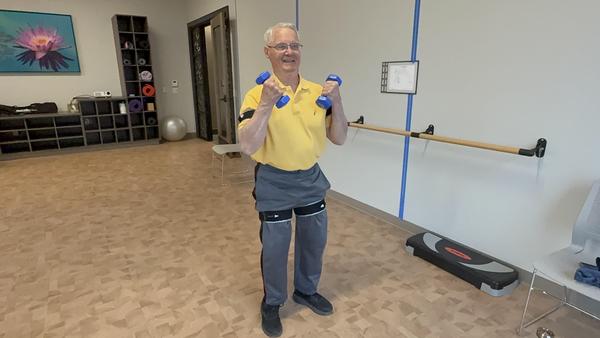
Pat’s BFR Training Results
Over the course of 13 BFR sessions, each lasting about 40 minutes, Pat and I worked on a combination of upper- and
lower-body exercises, including sit-to-stands, leg extensions, leg curls, suspension rows, wall presses, curls, overhead presses, and hand grip squeezes.
His results were very encouraging.
Pat
improved across every measured category, with the biggest gains showing up in strength-endurance and work capacity. His strongest improvements included:
- Leg press: +316.7%
- Left overhead press: +400%
- Seated row: +125%
- Right overhead press: +100%
- Chest press: +87.5%
- Left grip strength: +21.8%
What stood out to me most was not just that Pat got stronger. It was that he was able to complete far more repetitions with the same or slightly higher resistance.
That matters because daily life does not usually require one single maximum effort. It requires the ability to keep
going — to climb stairs, get out of chairs, walk longer, carry things, and move with confidence throughout the day.
Pat also noticed visible muscle growth and definition in his arms. One of the most meaningful wins was that he gained strength in a shoulder that had previously been injured and had been difficult to strengthen. He also noticed
improved endurance in his legs.
I also want to be honest about what BFR did not do. Pat has osteoarthritis in his knee, and the BFR training did not improve that arthritis. However, it also did not exacerbate it. For someone dealing with knee arthritis, being able to train the legs and improve endurance without making the knee
worse is still a meaningful outcome.
Why This Matters
One of the things I love about working with older adults is that the body can still adapt. Strength can still improve. Muscle can still respond. Confidence can still grow.
Pat’s results are a great example of
that.
At 82, he made measurable strength gains, improved endurance, and saw changes in muscle definition. That is not because we pushed recklessly or tried to prove a point. It happened because we used a thoughtful method, tracked progress, and worked within what his body could tolerate.
As we age, building and maintaining muscle becomes increasingly important. Strength supports balance, walking, stair climbing, getting out of chairs, carrying groceries, and staying independent.
But not everyone needs to train the same way.
For some people, traditional strength training works very well. For others, especially those dealing with joint pain, previous injuries, or difficulty tolerating heavier loads, BFR may offer a useful bridge. It allows us to challenge the muscles without relying only on heavy weights.
Is BFR Right for Everyone?
No. BFR training needs to be used
carefully and thoughtfully.
Before using BFR, we screen medical history. When needed, we also recommend medical clearance before beginning.
For most people, BFR can be a valuable addition to a
personalized strength program.
Pat’s results remind me why I’m excited to offer this tool. It gives us one more way to help adults build strength, protect independence, and keep doing the things they care about.
If you’re curious whether BFR training may be a good fit for you or someone you love, feel free to reach out. I’d be happy to talk through whether it makes sense for your situation.